
A University of Oklahoma student says she was punished academically for expressing her honesty, which held Christian beliefs, sparking a wave of public support and raising concerns about whether conservative and religious students are being silenced in college classrooms. The student, Samantha Fulnecky, a junior studying pre-med, has filed a religious discrimination complaint after receiving a failing grade on an essay in which she explained her Biblical views on gender. Her report led the university to place the graduate instructor on administrative leave as the controversy continues to grow.
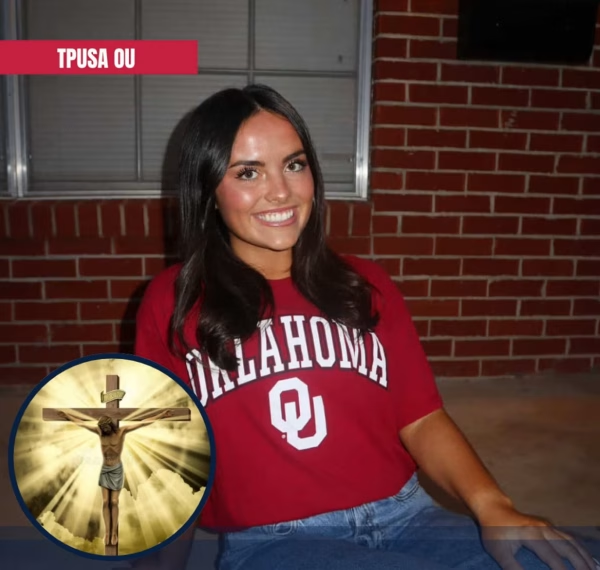
The assignment at the center of the dispute was a short reaction essay for a developmental psychology course. Students were instructed to read a research article on gender norms among middle schoolers and then provide their own reflections. To Fulnecky, the instructions were clear: she was allowed to present her opinion. She chose to write from a Christian perspective, grounding her arguments in Scripture and in her belief that gender is divinely created.
In her essay, Fulnecky wrote that the Bible teaches humanity was created “male and female,” and that teaching children otherwise “severely harms American youth.” She expressed concern that the gender ideology being promoted today contradicts her religious values and the teachings she has grown up with. “These beliefs are not just opinions,” she later said.“They come from my faith, and from what I believe is true.”
Despite believing she had followed the guidelines, Fulnecky received a zero out of 25 from teaching assistant Mel Curth, who identifies as transgender. Curth wrote that the essay did not meet academic expectations and called it “offensive” and rooted in ideology, according to Fox News. To Fulnecky, however, the issue was not about academic structure but about viewpoint discrimination.
“I very clearly stated my beliefs and stated what the Bible and God say about gender and those roles.” Samantha Fulnecky said.
Clearly being singled out, Samantha Fulnecky filed a formal complaint alleging that her religious beliefs were unfairly targeted. The situation escalated after she shared her story with Turning Point USA, whose campus chapter posted screenshots and a video online. Her account quickly went viral, drawing attention from Fox News Digital and prompting thousands of viewers to respond with support, many of whom said they had faced similar experiences.
In interviews, Fulnecky said the most important part of the story is standing by her opinions. “I would rather keep my integrity and get a zero than lie about what I believe,” she told Fox News. She encouraged other students, particularly Christians, not to be intimidated into silence. “It can be scary,” she said, “but your faith is worth standing up for.”
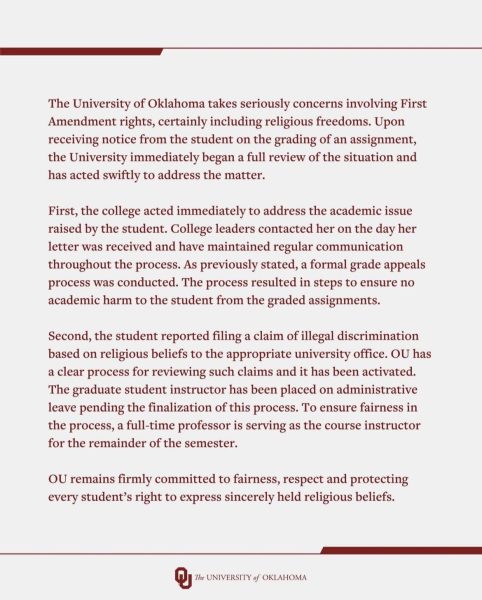
Following the heightened attention, OU issued a statement reaffirming its commitment to protecting students’ First Amendment rights, including religious expression. The university moved to ensure the failing grade would not impact Fulnecky’s final course grade and placed Curth on administrative leave while the complaint is reviewed. A full-time faculty member has taken over instruction.
Fulnecky’s critics argue that the essay did not follow academic standards. Still, her supporters respond that personal reflections, especially those requested in the assignment, cannot be disconnected from personal belief systems. Many religious students say faith-based reasoning is essential to their understanding of the world.
The investigation is ongoing, and Fulnecky says she hopes the outcome will help protect students from feeling pressured to accept ideological expectations. “I just want students to be able to speak honestly,” she said. “No one should be punished for their faith.”