
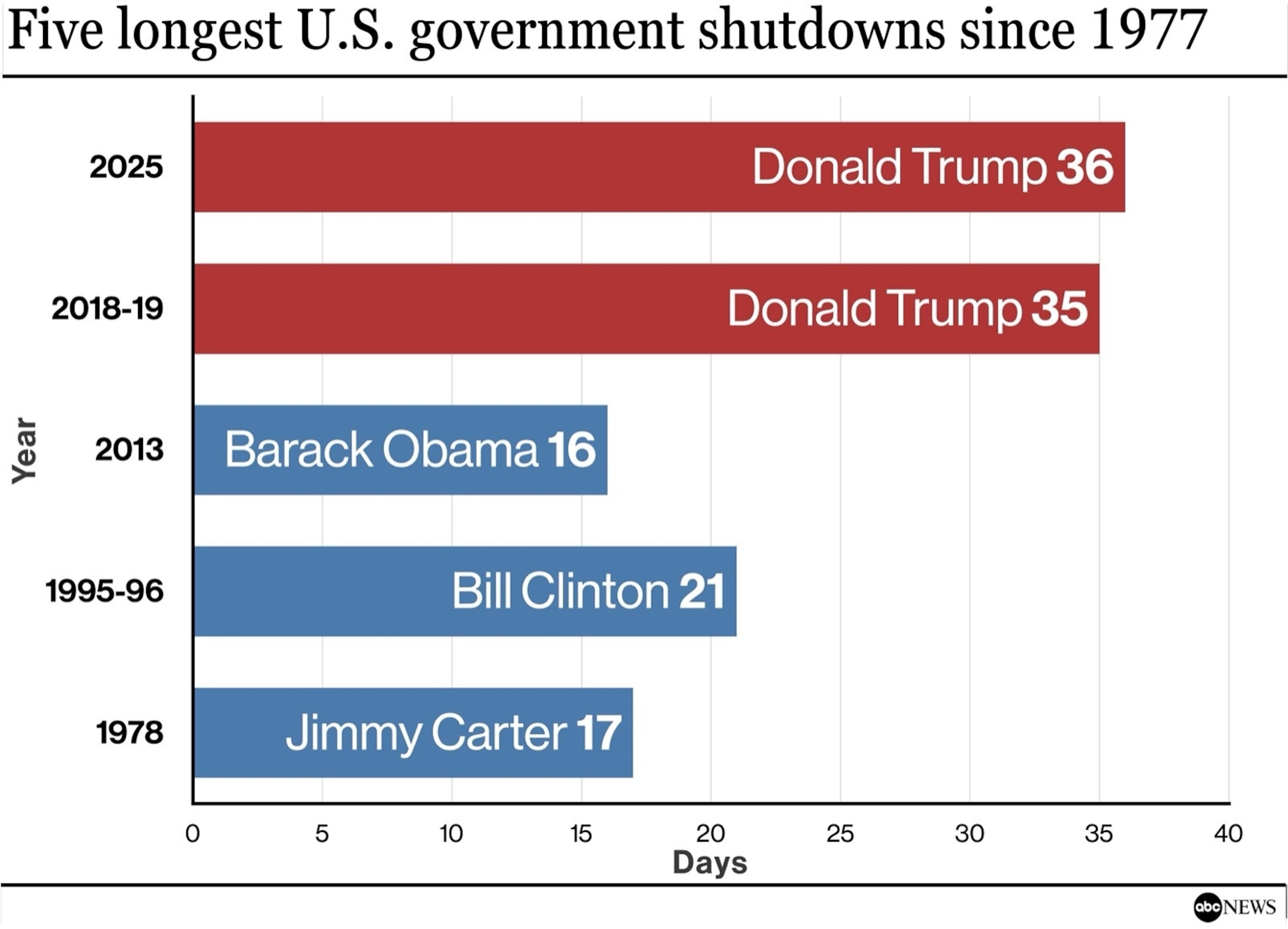
Every year, Congress has to decide on a budget for the government’s operations. Congress’s deadline to do this is September 30th, but if they cannot reach an agreement, the government will shut down. A government shutdown means that only essential government services continue to function. Workers in non-essential government jobs are furloughed or required to work for no pay. These government shutdowns often cause minor, short-term problems but rarely severe issues. To end a government shutdown, Congress must pass appropriation bills that set funding levels, and the president must sign them. There have been five government shutdowns in the United States since 1881. This is the longest to date at 43 days. The current shutdown is due to disagreements over health care policies, SNAP benefits, and immigration funding.
This government shutdown started when senators were seven votes short of passing a spending bill. The Republicans needed 7 Democrats to vote yes to pass it. The main topic under debate was the fight over health care. With the Affordable Care Act tax credits set to expire, Democrats fought to extend them and wouldn’t pass a bill without them. Nevertheless, Republicans resisted passing a bill that included these extended credits. With these subsidies, people could afford health care more easily. Without them, many people may be left without health insurance. Neither side was willing to give any leeway on their demands. This led to significant tension, and the ACA was among the main reasons the shutdown occurred.
SNAP benefits were another conflict during this shutdown. SNAP benefits help people who can’t afford food get nutritious food. During this shutdown, many people were left without their SNAP benefits, and therefore without food. Republicans sought to reduce SNAP program funding, but Democrats refused to sign any bill that cut it. Immigration was less critical but remained a key issue. Primarily, Republicans seek to increase spending on border security, whereas Democrats oppose it.

There were many effects of the government shutdown: thousands of people were left without pay or jobs, the economy suffered, and millions were left without government assistance. About 1.25 million government employees haven’t been paid since the beginning of the shutdown, and 670,000 of those workers are furloughed. One industry that experienced significant adverse effects of the shutdown was the airline industry. As the government shutdown exacerbated already dire FFA shortages, the FFA was forced to limit flights nationwide. This shutdown also affected the U.S. economy. Experts estimate that this shutdown cost $11 billion in economic activity.
On November 12th, 8 Senate Democrats gave up their stand and voted yes on a funding bill: Catherine Cortez Masto from Nevada, Dick Durbin from Illinois, John Fetterman from Pennsylvania, Maggie Hassan from New Hampshire, Tim Kaine from Virginia, Angus King from Maine, Jacky Rosen from Nevada, and Jeanne Shaheen from New Hampshire. This resulted in a vote of 222 to 209. This funding bill provided no extension of ACA tax credits, but Democrats got an opportunity to hold a vote on them next month. The approved bill offered full funding for SNAP benefits but did not extend Affordable Care Act subsidies.