What We Think Robots Can Do
Since the 1950s, people have believed that one day technology would surpass humans in evolution and become so advanced that it could spark a ‘robot revolution’ and take over the world. This idea has appeared in many forms of media, particularly in sci-fi films. The Age of Ultron, Terminator, The Matrix, and M3GAN are just a few examples of how filmmakers and writers influence the idea that futuristic technology is inherently evil.
An article from UC Berkeley discusses speculation about whether robots could actually take over one day. Jia Tianyong reports, “Many tech leaders, including Elon Musk and NVIDIA CEO Jensen Huang, claim that a similar approach will yield humanoid robots capable of performing surgery, replacing factory workers or serving as in-home butlers within a few short years.” However, UC Berkeley roboticist Ken Goldberg claims that many robotics experts disagree with this idea.
Ultimately, the idea that robots could overthrow the human population in the near future is simply not possible. But if the robot revolution isn’t happening, what are robots capable of?
What Robots Can Actually Do
Imagine getting taken care of by a nurse or talking to someone on the street, only to find out that the person  you’ve been interacting with is actually a robot! This idea is a major goal for many robotics companies. In the past month, the Shanghai robotics team ‘DroidUp’ has created a realistic humanoid robot that outshines most modern robots. The robot in question is called ‘Moya’. She is fully functional, with several futuristic features, including the ability to talk, walk, maintain eye contact, and express facial expressions, a ‘marathon bot skeleton’, and temperature-controlled skin to enhance human likeness. And although all of these features sound incredibly impressive, her training stops short.
Tesla has also been working on training its own robots, the Optimus bots, to collect data and perform factory work. What would it be like to work alongside a robot in a factory every day? Would you even keep your job,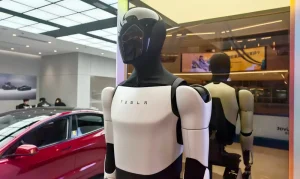 or would there be a different position for robots specifically? According to an article from Business Insider, “Tesla has been sharing sneak peeks of Optimus’ capabilities since the product was first announced in 2021. In 2024, the automaker posted a video showing the robot arranging batteries while tethered to an overhead support structure at the company’s lab in Palo Alto. The company said that it deployed two autonomous Optimus robots in one of its factories in 2024.” This shows that training is still in development and not nearly as advanced as many people believe.
Why Aren’t Robots Everywhere Yet?
Although much preparation has gone into robotic training, several setbacks prevent robots from being sold to the general public.
The Shanghai-based company DroidUp has been programming its newest bot, Moya, but she still has a lot of work to do to come close to ‘perfect’. A quote from News Atlas says, “But with all that in mind, it’s no surprise to find Moya has been met with mixed reviews. Most are the obvious ‘uncanny valley’ remarks, while others liken her to a Westworld model or even a walking ghost.” DroidUp is primarily training her to appear lifelike rather than for functionality, meaning that after they program her visual features to meet standards, it will still take a while to train her for actual services.
A different Scientific American article discusses the idea that while robots and A.I. are very intelligent and capable of performing many tasks their programmers assign to them, they can only do just that. If people continue to believe in robots walking among people or “taking over jobs” from workers, then robots will have to start predicting the unpredictable. Meaning, it will be a long while before robots can be used in homes or work alongside humans because they lack the ability to understand dependable situations. For example, if a robot is trained to work as a cashier at a fast-food restaurant and is programmed to handle specific tasks and respond to specific scenarios, it won’t know what to do or be able to improvise dialogue or actions in response to random events. So if a customer walks in with ordering issues or wants to change their order, the robot employee will likely have difficulty resolving the issue.