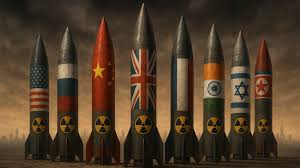
Nuclear weapons, highly destructive devices—normally viewed as a weapon capable of mass death. Its public opinion is similar to its definition. The process of such a highly advanced weapon is complex to say the least, it “rapidly releases nuclear energy, either through fission (as in the bombs dropped on Hiroshima and Nagasaki) or a combination of fission and fusion (as in a thermonuclear or hydrogen bomb).”
When nuclear weapons are brought up, a common question that follows is usually something along the lines of inquiring what separates nukes from other weapons. After all, the common question is: isn’t the definition of a weapon to inflict physical harm upon someone or something? Other forms of destructive devices can be life threatening towards a large group of civilians as well, can’t they? Simply speaking, “Nuclear weapons use fissionable materials to fuel an explosion, whereas conventional weapons do not. Only a relatively small number of radioactive materials are fissionable, such as Plutonium-239 or Uranium-235. In addition to their sheer destructive power, nuclear weapons also threaten human life through the radioactive fallout they disperse.”
The dangers of a nuclear weapon don’t stop at death; effects like radiation that cause disfigurement or health issues that potentially could be passed on for generations, and even environmental damage occurs when these deadly arms are fired. What is terrifying about this is that there is no healing or return to the world’s previous state once this damage is done. So, if we’re viewing it from this general perspective, the answer to whether nuclear weapons are “good” is obvious. However, the world isn’t always black-and-white. Most things—if not all—have both beneficial and detrimental consequences.
The first thing we should examine when we consider the “good” side of nuclear weapons can be summed up in one word: Deterrence. A source of defense, nuclear weapons play that part well. The factual evidence is here: “Since World War II, the nature of war on the planet has changed, Pinker said. Nations that might be considered great powers, which once warred regularly, have had an extended period of peace, colonial wars have tapered off, and the most common form of warfare now is civil war, which is less deadly than major conflicts between large nations.” By Alvin Powell. In short, we are currently living in the longest era of peace ever recorded. To dig deeper, after the atomic bombing of two major cities in Japan, the Axis surrendered to the war, allowing the Allies to achieve victory.
The total death toll of World War II by nuclear bombs is a mere 0.3 percent. After that, no major wars have occurred thanks to the threat of Nuclear weapons, and the potential execution of said weapons. The end justifies the means, right? Nuclear weapons may instill fear in people, but if they protect and ensure the physical, mental, emotional health, and economic stability of all, it’s clearly more favorable in terms of advantages, right?
Nuclear weapons can cost up to trillions of dollars. “From 1940-1996, the United States spent a minimum of $5.5 trillion on its nuclear weapons program,” and with tax prices, in addition to inflation towards the cost of weapons, the prices surely have increased. However, if we focus solely on the cost, we miss the benefits again. When it comes to the final question in this discussion, the only one that lingers is this: Is money or the safety of you and your loved ones more important?
Because after Ukraine left the soviet union, they, at the time, “held the third largest nuclear arsenal in the world, including an estimated 1,900 strategic warheads, 176 intercontinental ballistic missiles (ICBMs), and 44 strategic bombers. By 1996, Ukraine had returned all of its nuclear warheads to Russia in exchange”. It was because the loss of protection from the arsenal left Ukraine vulnerable to attacks. Furthermore, most Ukrainian civilians had spoken out that they wished for their nukes back.

Besides, the chances of nuclear war are relatively low due to MAD (mutually assured destruction), along with the country’s policies. For example, China has a “No First Attack “ policy, which states that it will not resort to the use of its nuclear weapons unless it is attacked first by a nuclear arsenal.
Despite this, shouldn’t we consider the possibility of setting off nuclear weapons accidentally or unauthorized? Cyber-terrorist attacks, accidents, miscalculation, or even unapproved access. However, the chances of these hypothetical situations are unknown. Sure, in the past, they may have demonstrated similar aspects, but with advanced technology, the statistics are now unstable.
No matter how we look at this, nuclear weapons can be seen as both “good” and “bad”. What determines this is what we choose to value. If we carry a more idealistic view with a constant search for hope, since humanity, at the end of the line, can do nothing but dream and try to achieve. Or if we look through a more realistic view, and come to the understanding that humanity cannot be saved, it remains hopeless because humans are inherently evil, and will never fully give up the concept of violence. Is it better to dream and achieve, or give up and face what society has deemed as “realistic”? Either way, the conclusion of this writing is not whether nuclear weapons should be labeled as moral or immoral, but to give understanding that everything has a side that can be seen as good or bad, raising awareness that we cannot solely label something based on its potential use.