

As of last week, there has been a growing debate about whether the United States is at war. Why, you may ask? Well, on February 28th, while most Americans were sleeping comfortably in their beds, they were awakened with the news, either via television news or scrolling through social media on their phone, of a recent bombing in Iran.
This bombing was done at the order of United States President Donald Trump with the aim of toppling the regime in Tehran and destroying Iran’s nuclear program. The reasoning to aim for the program was a result of multiple failed negotiations over Iran’s
 nuclear program with the U.S. and Israel. The regime is otherwise known as the Islamic Republic of Iran, founded in 1979 and resulting from the Iranian Revolution, which shifted the country’s “political structure, foreign policy, legal system, and culture”. This new regime and era for the country, under the leadership of Ayatollah Ruhollah Khomeini until his death in 1989, was seen to shift from a domination of revolution onto theocratic republic through costly and bloody wars with Iraq. The country’s republic, however, did not result in the change that was believed, as this brought about an era of re-Islamization of Iraq by purging itself of non-Islamists.
The Violence Occurring in Islam
The allies, the U.S. and Israel, formed a conjoined attack where a bombing on an Iranian primary school on Saturday that “constituted a grave violation of humanitarian law” on peace and security. The missile attack was known to hit a girl’s primary school, resulting in over 150 casualties and 100 wounded, in southern Iran. This was reportedly done so with the intent, according to current U.S. President Donald Trump, of eliminating Iran’s “nuclear and missile programs, destroying the country’s navy, and changing its leadership,” according to the Council on Foreign Relations, a non-partisan and independent source of international relations.
Along with the attack on the primary school, there has been a confirmed and successful attack on the Iranian Supreme Leader during the opening strike of the war. Late on Saturday afternoon, Ayatollah Ali Khamenei was confirmed dead as a result of a targeted assault by the Israeli military. With the larger portion of Iran’s senior leadership being confirmed deceased as well.
Additionally, as of March 3rd, more violence has spread, with the recent bombing of Iranian hospitals. It was counted as a total of 13 hospitals in Iran and one in Lebanon that were targeted, as of right now unknown who targeted these institutions, where there is a reported four medics killed and 25 others injured. Prior to the attack, Iran’s capital, Tehran, was being evacuated due to nearby violence and explosions. 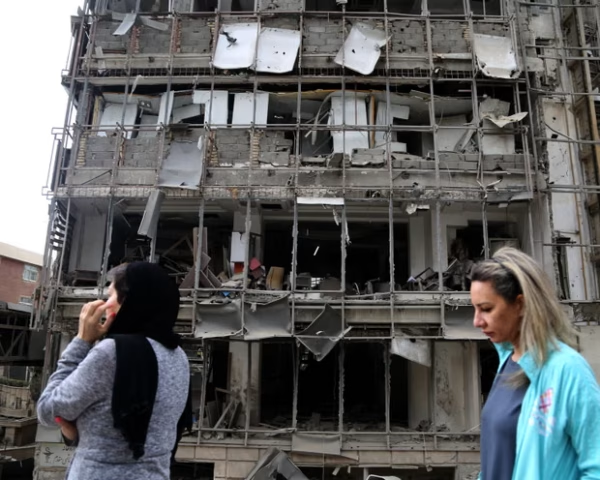
These attacks are clearly going to be ongoing as the Israeli military has “begun bombarding both Iran’s capital, Tehran, and the Lebanese capital of Beirut,” according to Aaron Boxerman, who is actively reporting from Jerusalem as of March 3rd.
The war has been increasing past the Middle East through resistance from Iran and allies of the U.S. and Israel. The ally of the U.S., the United Arab Emirates, which is a federation of seven sovereign emirates, has been feeling a big part of the war in Iran. This union comprises the countries of Dubai, Abu Dhabi, Sharjah, Ajman, Umm Al Quwain, Fujairah, and Ras Al Khaimah. Since the war, the number of countries that have felt and faced some sort of consequence of the first bombing has included Qatar, Kuwait, Bahrain, Oman, Saudi Arabia, Jordan, Lebanon, Iraq, Cyprus, and Azerbaijan.