
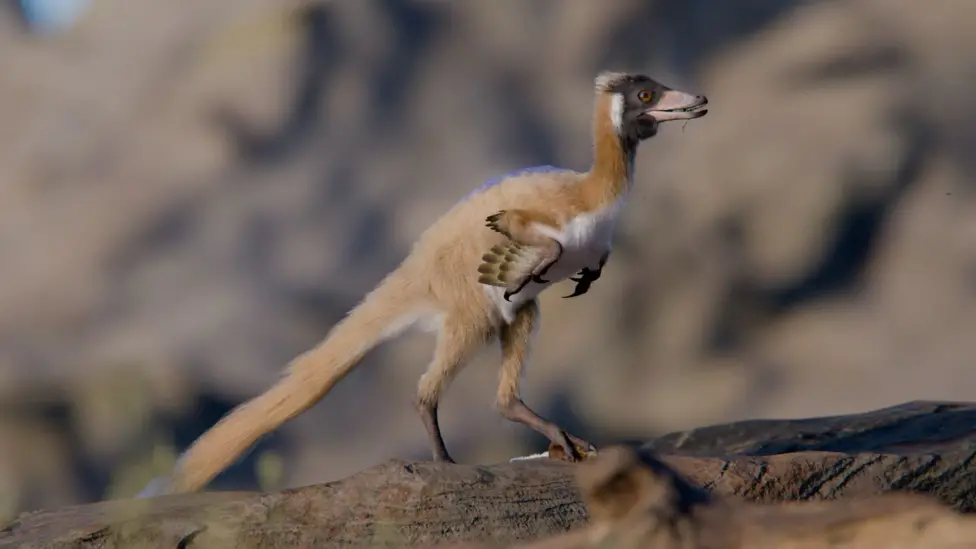
The fossil of one of the smallest dinosaurs ever discovered, Alnashetri Cierropoliciensis, refutes the theory that its lineage became smaller due to ant-eating habits, as reported in a Nature article.
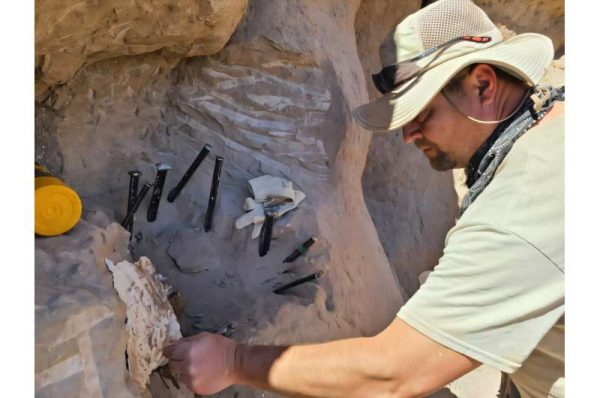
The Alnashetri was found in La Buitrera, the Argentine province of Rio Negro. This was known as the Kokorkom Desert during the Cretaceous, which is where the Alnashetri lived. It belonged to the Alvarezsaur family. Over generations, the Anlashetri’s relatives evolved from having three fingers to one big finger and smaller arms, and from eating mainly ants and small insects to eating mainly ants and small insects, signaling their miniaturization. However, because these small dinosaurs had developed these features before adopting ant-eating diets, this disproves the theory that they became smaller as a result of those habits.
The Alnashetri had long, well-developed arms, sharp teeth, and thin legs. Although this feathered animal seemed to share some of its features with birds, it could not fly. It was carnivorous and usually ate small animals and insects. Additionally, it had a relatively long tail compared to its body. “Its body resembled that of a rooster, but with a long tail,” says paleontologist Sebastián Apesteguía.
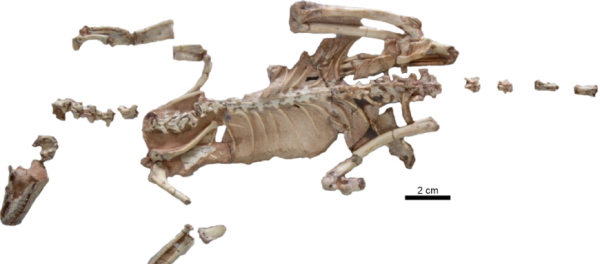
This fossil was discovered in 2014; however, it has been studied for the past 12 years, according to Reuters. The first-ever discovery of this dinosaur was in 2004, with an incomplete pair of legs. Now, scientists are looking at a near-complete fossil of one of the smallest dinosaurs in South America. The bones were well-preserved as the sand covered the carcass after death.
The Alnashetri shares ancestry with the Tyrannosaurus rex, since both are theropods with hollow tail bones. Furthermore, it was most likely female and had feathers. Scientists believe it was female due to the calcium buildup around the bone tissue on the rear. The dinosaur discovered was approximately four years old when it died, an adult upon observing the bone through a microscope, according to Phys.org.
The Alnashetri was about 40 cm tall, 70 cm long, and weighed about a kilogram. It is comparable in size to a chicken or a crow, making it one of the smallest dinosaurs discovered in South America and rivaling small dinosaurs found globally.
It lived about 95 million years ago during the Cretaceous period in deserts, according to the BBC. This early version of the Alvarezaurids shows scientists how parts of the family came to eat insects and became smaller.
The fossil was missing the roof of the skull, most of the tail, part of the forelimb, and a finger. Paleontologists are now studying more of Argentina and trying to find more fossils related to it. After conducting research, scientists found that the fossil originated from the landmass of Pangea before the continents separated, meaning it did not travel through the oceans to reach other parts of the world.
The discovery of the Alnashetri Cierropolociensis proves that not only was the Cretaceous period an era of massive beasts, but also of small organisms, which is changing how scientists view dinosaur species and their evolution. The size reduction occurred before the development of ant-eating habits, proving that diet was not the reason for miniaturization, as the Alnashetri had larger arms and sharper teeth, which could also eat insects and other animals.