Students worldwide have grown accustomed to using ChatGPT or other AI tools for homework and other tasks, but few realize the impact this has on our future and national security.
One reason why AI in national security is dangerous is that it is prone to hacking. If and when an AI system is hacked, the hacker can steal any information at their disposal, which other countries may use for military purposes, such as planning attacks and decision-making. Evidently, this poses a moral dilemma because we are using AI to defend ourselves and make decisions for us. It is not up to AI to decide who lives and dies; it’s nobody’s decision, and a simple programming mistake can cause multiple failures and disasters.
As AI has evolved over the years, a standard integration has been jobs. This demonstrates that although we are creating new jobs, we are also taking jobs away from those who have spent years studying.
According to a post on National University, “23.5% of U.S. companies have replaced workers with ChatGPT or similar AI tools”. AI is constantly replacing people and their roles in society. To put this into perspective, imagine you are an adult with a master’s degree and have spent many years working on the security of infrastructure for your country. Your boss randomly decides one day that an intelligent computer will replace you.
This leads to the next point, cognitive degradation. With the recent integration of different language models, most evident in generative AI, most students process and gather information differently. A study, according to Just Security, shows that “GenAI use shifts a brain’s focus from gathering information, solving problems, and analysis to verifying AI-generated information, integrating its responses, and stewarding the AI as it does the task”. This suggests that, by utilizing AI, people tend to focus on the verification of success rather than the learning process itself, indicating that learning ultimately depends on human effort, rather than relying on language models to do our work for us. This is correlated with national security because workforce development and education play a significant role in the way our nation can change.
Another reason why AI should not be used for national security purposes is that it could cause a nuclear war. This may seem like an exaggeration, but historically, we have come close to a nuclear war way too many times. That was by human judgment, not AI. Now, imagine a computer has the decision to end the world with a single command. Keep in mind that AI does not have the same morals as most humans. If one wrong decision is made, it could be the beginning of the end of the human race.
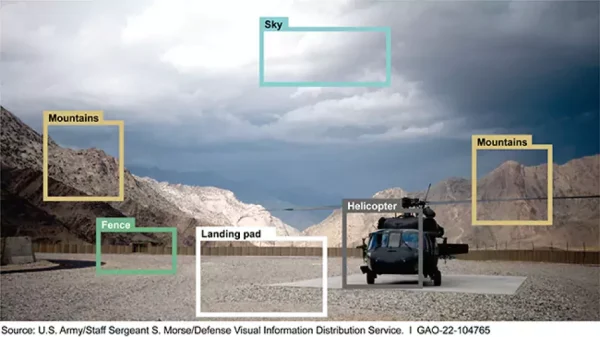
One typical example of nearly starting a nuclear war would be the 1983 false-alarm crisis. Essentially, a Soviet officer misinterpreted a signal indicating that the US was attacking the USSR with five intercontinental ballistic missiles (ICBMs), which was actually a reflection of sunlight due to cloud formations. According to Brookings, “the actual human being improvised, using instinct more than formal protocol, to arrive at the correct decision when faced with the unthinkable possibility of an actual nuclear war”. This establishes that an AI faced with a decision like this would have most likely chosen to retaliate.
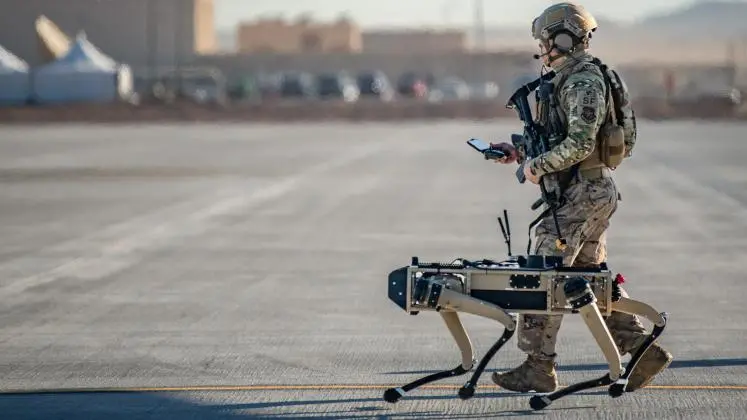
Not only can AI in national security start a nuclear war, but it also aids in the creation of weapons. This is good to an extent. With AI-powered weapons, humans can stay out of the battlefield and let AI handle the dirty work, meaning that fewer people engage in violence and die in war or other conflicts. Still, because most countries try to prevent war due to the human cost, “it weakens the association between acts of war and human cost, and it becomes politically easier to start wars, which, in turn, may lead to more death”, according to an interview conducted with Kanaka Rajan, a neurobiologist and assistant professor at Harvard.