

What is ICE?
U.S. Immigration and Customs Enforcement (ICE) is a federal law enforcement agency that enforces immigration laws within the United States. The agency plays a crucial role within the federal government by enforcing immigration laws and legal standards, protecting national security, and conducting investigations into transnational and national crimes. ICE’s main purpose is to protect the United States and its citizens by enforcing federal criminal and civil laws governing border control, customs, trade, and immigration.
The History of ICE
ICE began with the Tariff Act of 1789, signed into law after the Founding Fathers approved the Constitution. This was the first essential piece of legislation. The act served two purposes: to create industries and increase revenue to pay off the debt from the American Revolution. Because of that act, it laid the foundation for the U.S. Immigration and Customs Enforcement and the Homeland Security Act.
In November 2002, Congress passed the Homeland Security Act in response to the September 11, 2001, terror attacks. Signed by President George W. Bush, it created the U.S. Department of Homeland Security (DHS), which consolidated 22 organizations into a single department to prevent terrorist attacks, address vulnerabilities, and coordinate emergency responses. In March 2003, the Homeland Security Act was the largest government reorganization, creating the Bureau of Immigration and Customs Enforcement, now known as U.S. Immigration and Customs Enforcement (ICE).
Currently, Congress has granted ICE civil and criminal authority to protect national security and public safety. The agency has over 20,000 law enforcement and support personnel in more than 400 offices in the United States and around the world. Furthermore, ICE has expanded into three branches that support and define what ICE is today.
How is ICE bound to the Constitution and Government?
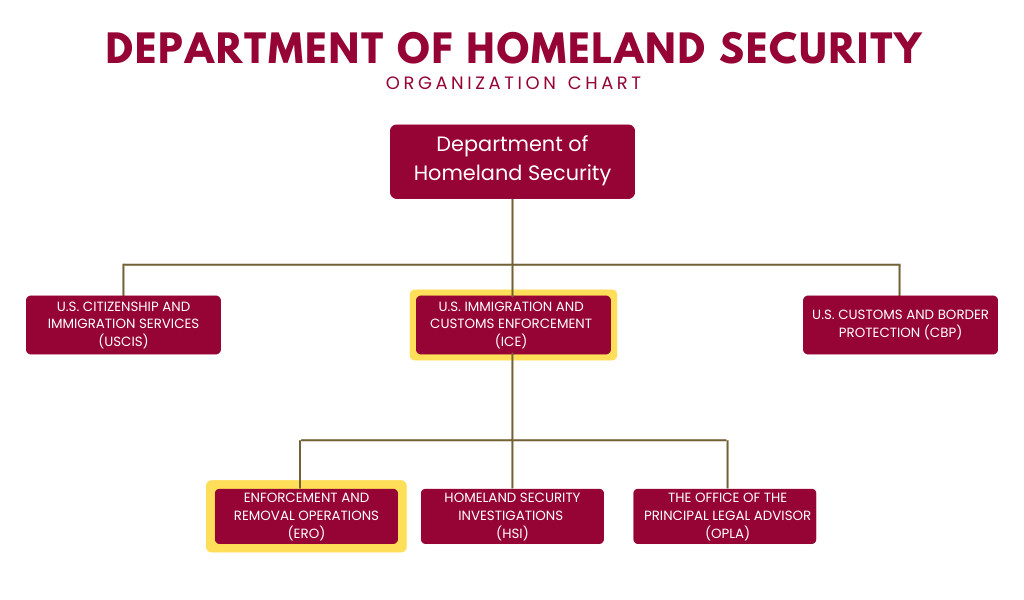
The U.S. Immigration and Customs Enforcement is an agency within the Department of Homeland Security, which is an executive-level branch that protects the U.S. from transnational attacks and the border, that is divided into three categories: the Enforcement and Removal Operations (ERO), Homeland Security Investigations (HSI), and the Office of the Principal Legal Advisor (OPLA). Many people view ICE as an immigration enforcement and removal agency; these three components are crucial to how the agency operates and what it does.
- Enforcement and Removal Operations (ERO)
Enforcement and Removal Operations (ERO) manages the immigration enforcement process. They look over identification, arrest, detention, and removal of aliens who have committed a crime and/or are illegally present in the United States. Furthermore, ERO manages the agency through various operations, including the Enforcement Division, the Field Operations Division, the ICE Health Service Corps (IHSC), and other divisions.
- Homeland Security Investigations (HSI)
Homeland Security Investigations (HSI) conducts federal investigations into the illegal transportation of people, goods, money, contraband, weapons, and sensitive technology, both into and out of the United States. The main purpose of the Homeland Security Investigations (HSIs) is to enforce federal immigration and customs laws and investigate transnational crime, or crimes across the U.S. border that could affect one or more countries. before it enters the United States. Their offices are currently located in 235 cities across the United States and in 90 offices in more than 50 countries.
- The Office of the Principal Legal Advisor (OPLA)
The Office of the Principal Legal Advisor (OPLA) provides legal services to ICE programs and offices, as well as advice and prudential counsel to ICE personnel on their divisions and law enforcement. In addition, OPLA has more than 90 offices in 25 locations throughout the United States. OPLA’s main purpose is to serve as the exclusive legal representative for U.S. Immigration and Customs Enforcement (ICE) and the Department of Homeland Security (DHS) in immigration removals. immigration courts, handling cases involving criminal noncitizens and terrorists
- The Fourth Amendment
“The right of the people to be secure in their persons, houses, papers, and effects, against unreasonable searches and seizures, shall not be violated, and no warrants shall issue, but upon probable cause, supported by oath or affirmation, and particularly describing the place to be searched, and the persons or things to be seized.”
The Fourth Amendment protects individuals against unreasonable searches and seizures by the government, meaning that courts have helped to protect everyone inside the United States, regardless of immigration status, under this amendment. This means ICE and its offices operate under this amendment and are subject to the same constitutional limits as other federal law enforcement agencies. As a result, courts could suppress evidence, dismiss cases, or find actions unconstitutional under federal law enforcement, such as stopping someone, deeming and arresting, entering a home, or making an arrest, if they were not done in accordance with the limitations of the Fourth Amendment.
Common Questions regarding ICE
- Who is ICE legally allowed to arrest vs. detain?
ICE has the authority to arrest and detain noncitizens who are removable under immigration law; however, it should do so only with a reasonable belief that a citizen is removable under the Immigration and Nationality Act. ICE does not have legal authority to arrest U.S. citizens unless they are under a lawful basis or committing criminal activities in immigration or toward non-citizens.
- What level of force is permissible?
ICE’s force is regulated by the Constitution and federal regulations, including the Fourth Amendment. The agency must proceed with non-deadly force when reasonably necessary; however, ICE can use deadly tactics to protect against an imminent threat of death or serious harm to the country and its citizens.
- Can ICE enter a home without a warrant?
Under the Fourth Amendment, homes are afforded the highest constitutional protection, and ICE or another federal immigration agency cannot enter them. ICE must obtain consent to enter from the resident, a judicial warrant, or an emergency involving imminent danger, destruction, or hot pursuit. Only an administrative immigration warrant signed by an ICE officer would not be satisfactory for home entry. If these exceptions are not met, entry into the home is unconstitutional.
- Where can ICE legally operate?
ICE is legally allowed to operate in public places, such as streets or sidewalks. On private property, they must have a warrant or act through exigent circumstances. However, enforcement is regulated by the Fourth Amendment, and arrests and detentions must be based on suspicion or cause.