
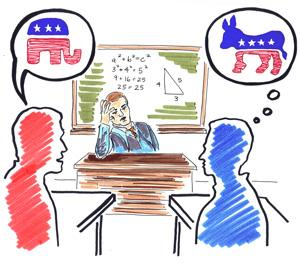
In an era when politics dominate social media feeds and dinner-table conversations, students are bringing those debates into the classroom. The real question is not whether politics will be discussed in school, but whether teachers should lead those conversations. With classes like government, economics, and language arts, it can be difficult to avoid politics. But at what point should teachers draw a line in the classroom? Being impartial as a teacher is very important for encouraging students to develop their own views on political issues. This is why there are many rules and guidelines for teachers regarding politics. The National Education Association emphasizes that teachers should facilitate discussion without promoting their personal beliefs. There are so many ways the conversation can lead to negative outcomes, including feelings of distress, a lack of boundaries, a lack of respect, or the spread of misinformation.
The Development behind Collaboration among Teenagers
As teachers, it can be difficult not to butt into students’ political conversations, but when teachers interfere, they can end open-minded discussion. As teenagers grow, so do their minds. As the mind expands, more opinions develop, and it begins to shape who these students become for the rest of their lives. A study published in Child Development found that adolescent cognitive development increases the ability to think critically and take perspectives. This essentially means teenagers are learning how to weigh different sides of an issue. Everyone deserves the right to draw their own  conclusions and form their own opinions on different topics, including politics. Diana Hess, an education expert, explains that teachers should create spaces for discussion while maintaining a neutral stance so students can further elaborate on controversial issues without feeling obligated to agree. As a teacher, interfering with that can close off the comfort students have to speak up about matters they care about, and it can close off any collaborative, critical thinking about our current world and government. For example, if a teacher expresses a political view during a lesson on climate change, some students may feel pressured to agree rather than form their own opinions. The pressure may be unintentional, but it can still shut down any critical or collaborative thinking.
Comfort is a Necessity on School Grounds
Comfort is a very important part of a school environment, and it can affect how students feel about the campus they legally have to attend every day. Students should feel comfortable enough to respectfully express their thoughts and opinions in any situation, without feeling judged or uncomfortable. When teachers start discussing political opinions in the classroom, especially without prompting, it can create discomfort and tension. Students may start to feel that boundaries have been crossed because school is not about taking sides or promoting aggressive political opinions; it is about nurturing young adults and guiding them to make their own decisions. A high school should be a non-biased environment that teaches kids how to think for themselves, not a place to sway people’s opinions for selfish gains. In many reported cases throughout the U.S, parents have filed complaints when teachers openly supported political candidates during class time. In some districts, teachers have faced consequences for promoting or endorsing political candidates. For example, policies from the Los Angeles Unified School District state that employees must remain politically neutral in their duties and may not use their authority to pressure people to agree with their personal political views. Multiple reports show that these situations are not hypothetical and will continue to happen if people stay closed-minded.
The Impact of Misinformation
Talking politics in the classroom can also be very tricky, considering the amount of misinformation being spread. As many high schoolers approach senior year, they also reach the legal voting age. The spread of misinformation can undermine democracy, where people are supposed to vote based on their real interests and opinions. This can decrease what literature calls “real voting”. Young adults, especially those still in high school, are highly susceptible to misinformation and prone to spreading it. This is seen mostly in social media, but teachers speaking on politics increases the chances of incorrect voting. Incorrect voting can be referred to as voting under the influence of  misinformation. Teachers are trusted authority figures. If they unintentionally share incorrect information, students may not question it. Because students often view teachers as reliable sources, misinformation shared in a classroom can carry more weight than something seen online. Therefore, neutrality protects students from unintended and unsolicited influence. Even if teachers do not realize they are spreading misinformation, the likelihood of it happening in a political conversation is high and should be avoided altogether. School districts should reiterate the importance of regulating what teachers say in the classroom, especially in a political context. This is clear for many reasons and should not be taken lightly. School systems should be environments where young adults figure out their own minds and opinions, not environments where adults impose their opinions on us.
A Necessary Balance
While some may say that politics in the classroom can help students talk about politics respectfully, these subjects should be taught by the curriculum, not by personal political beliefs. Too little politics leads to too little critical thinking, but students must also learn to discuss controversial subjects maturely. This is a difference between teaching politics and teaching opinions. The school district needs to remind teachers to monitor classroom conversations, especially when it comes to politics. Schools should be places where young adults discover their own minds and opinions, not places where adults tell students what to think.





Brooke Ransbury • Feb 25, 2026 at 12:19 pm
This is very great, Isabella! Very proud of you!
Isabella Isom • Feb 23, 2026 at 3:27 pm
Love this, Isabella! You’re such a great writer! 🙂