

Before we begin, I would like you to participate in a small task for me.
Assuming that you watch the news to even a lesser extent – most notably, stories from across the nation and worldwide – I would like you to list as many of the biggest events you can think of. Fairly recent ones, maybe within the past few months or from years prior. They could be isolated instances or a series of occurrences directly influenced by others that came before; they could also include prominent or fairly unheard of individuals, and have any amount of effect on your life or none at all.
Whenever you feel like you’ve collected enough, compare these stories to one another: in how many of them is something bad happening?
If it’s not the majority, then that’s arguably good for you. If most or even all of them involve some conflict or unfortunate circumstance, to say the least, then you’re not alone. Not even a little bit.
The Negativity Bias
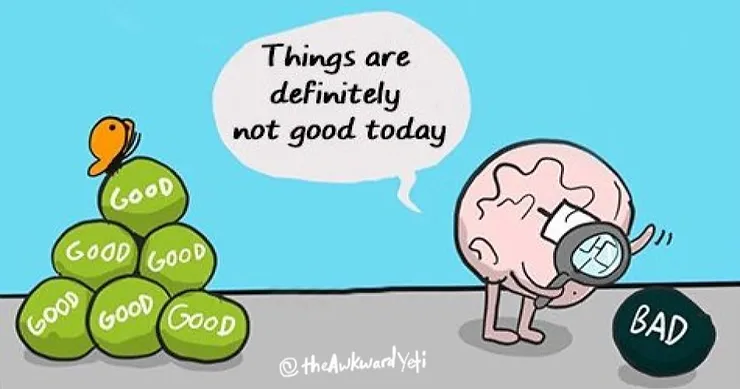
There’s this phenomenon in the human psyche that shows up in lots of places, but it’s especially prevalent in our intake of stories. We have what can be called a negativity bias: our brains are intrinsically wired to shift our attention more toward negative things than positive ones.
A report from the National Library of Medicine explains that people tend to direct more attention to negative stimuli from infancy. This phenomenon may occur as a result of this information triggering “threat responses” – generally, you’d want to put more energy into preparing for an unfavorable instance than you would one without foreseeable issues or complications. As a result, in our subconscious effort to keep aware of and prepare for any dangers, undesirable or unfortunate events tend to stand out more than contrasting ones.
 Furthermore, on a less related topic than it initially appears, it’s been analyzed that readers have an immensely short attention span: of the 89% of readers getting their stories online, the general lot of them spend less than 5 minutes a month on the top 25 news sites combined. This makes the competition for reader attention very intense, putting pressure to create the right headlines and report on stories that get the most attention – and, as we’ve covered, these tend to be negative in nature.
This phenomenon is supported by the Decision Lab, which delves into its prevalence and consequences beyond news and into the realm of self-esteem. Through the use of a “learning of own performance” or LOOP task developed around post-performance feedback, it was found that individuals show a negativity bias toward updating their own performance, but when listening to the feedback on the performance of others, they attended equally to positive and negative information.
The Problem with Negativity Bias
This disparity in self-evaluation, regardless of accuracy, can be a significant contributor to low self-esteem and a pessimistic, self-deprecating outlook that’s growing among the populace today. When most, if not all, of what you hear or think about brings you down, maintaining a light outlook and attitude grows increasingly difficult over time.
Psychology Today takes a deeper look at these consequences. An experiment they conducted with 330 American volunteers – wherein 3 separate groups read positive, negative, and neutral stories and were asked questions, such as their predictions of the country’s future – resulted in a disparity in the outlooks on future events aligning with the news they read. They concluded that negativity bias “shatters” people’s hope for the future, discouraging them from being proactive in helping their communities and creating a positive influence on society, just as having a positive attitude and hope would.
Arguably, this reduction in proactivity ultimately stems from the prevalence of the stories and events that cause it. If you and many others are less proactive about improving your community, the problems will be easier to remain as prevalent and entrenched as they are, prompting further coverage and contributing to this cycle of despair.
However, in line with the theme of this topic, all hope isn’t lost. Cycles like this can be broken with the right mindset and some effort – there are several strategies we will cover that can help one accomplish this.
Counteracting the Disparity
 For starters, a disclaimer: I don’t believe one should never hear about bad news. Somewhat apart from the survival benefits that gave negativity bias a place in human cognition, awareness of issues or tragedies must be spread across communities so they can better address them. For that reason, negative news stories shouldn’t be ignored entirely – balancing your knowledge is key to understanding the full picture and the nuance that comes with it.
Of the several ways, probably the easiest to counter this is by being “skeptical of your bias,” as Ethics & Journalism puts it – essentially, maintaining awareness of this issue and helping others recognize it will help on its own, mitigate feelings of hopelessness by calling into question the impact of the negative news as a whole. This actually served me well in the last news article I’ve written, in which President Trump removed an Obama-era climate endangerment finding that restricted automobile manufacturers into designing more environmentally friendly cars; I initially assumed that this would mean an even more rampant climate catastrophe, but after reading more sources and gaining further insight, it didn’t seem AS bad – for one, car prices and availability may go down for consumers (albeit at a cost of increased health concerns), the country overall doesn’t have as big of an impact on global climate change as other contributors, only accounting for 11% of global emissions. Not entirely good, of course, but not totally bad – this is an example of nuance in the stories we read, which isn’t often immediately seen by readers and thus missed.
Another valuable way to find balance is to actively search out positive stories. In today’s age, we live in two worlds – the physical world and the Internet/social media. Our attention is constantly glued to the latter, which constantly feeds us bad news without us having to search for it, while rarely giving good news the same treatment. For that reason, searching for it in just a little bit of time will make up for that difference, and maybe even improve your mood for the day. For example, just in the first half of last year, renewable energy actually outpaced fossil fuels in electricity production for the first time in history – not by much, with renewables generating 34.3% of global electricity compared to coal for 33.1%, this push towards cleaner electricity production by nations like China and India despite the weaker renewable infrastructure can be a good sign for a generally cleaner future to come. This was a story I found on my own time, not sent to me by a usual news source.
If you’re looking for another angle, both this source and Psychology Today recommend putting stories into a broader context beyond the story itself. In a way similar to how the stock market fluctuates periodically, any circumstance below a major scale may be an occasional high or low over a set period. Nothing is ever bad or good forever; changes in state of affairs are guaranteed, even if it doesn’t feel like it. Crimes and conflict, unfortunately, happen, but it doesn’t necessarily mean that society will collapse.
Closing
There are additional ways these sources recommend bringing balance to your learning, but in essence, the key is to keep an open mind.
Now more than ever, people are growing ever dependent on popular media for learning about what’s happening around them – as we lose our independence in research and understanding events for ourselves, it becomes easier and easier for those sources we rely on to construe our perspectives on things.
As a matter of principle, organizations providing news to the public are tasked with displaying an accurate and nuanced account of events. Despite this, they have an even greater incentive to blow things out of proportion to turn a greater profit. This makes it all the more vital to fight ignorance by doing your own research and coming to your own conclusions, lest we continue down the road of despair.