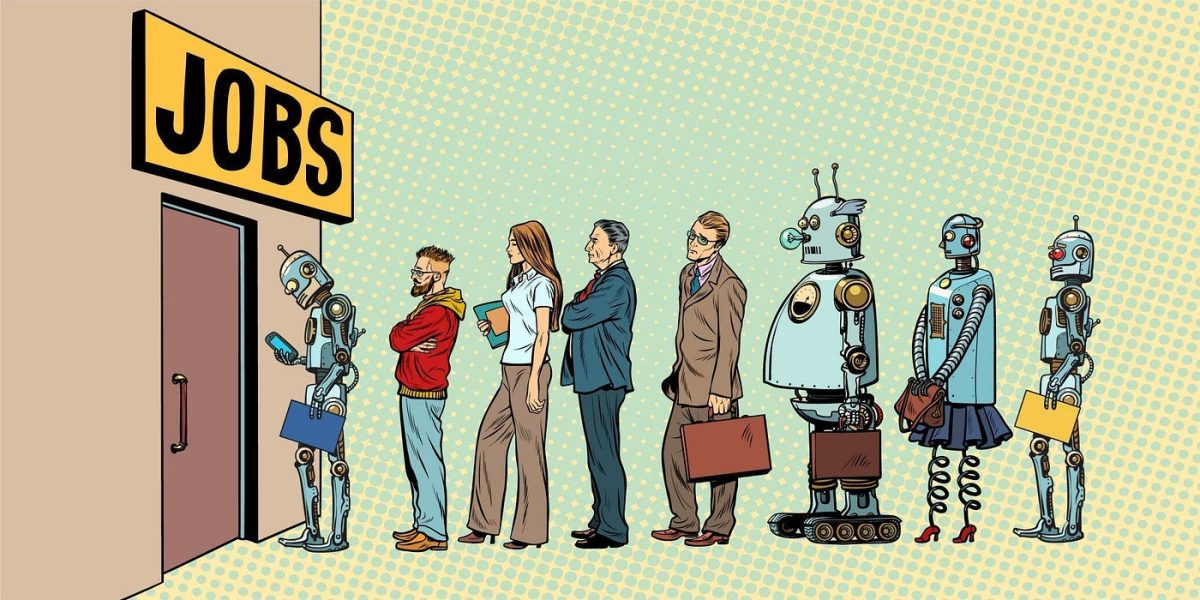
Roughly 16,000 net jobs are being lost per month to AI. That’s 192,000 per year. After 2025, the rate at which jobs were displaced by artificial intelligence increased significantly. This rapid influx in the past two years has caused anxiety within the white-collar job industry.
Erin McGoff, founder of the career-education platform, AdviceWithErin, says that “I have people who say that they, every day, feel like they’re training their replacement.” Her employees aren’t the only ones who feel this way, either. A recent poll found that 30% of Americans believe their jobs will become obsolete due to AI, and 70% believe that the development of AI will ultimately lead to fewer job opportunities.
However, this sort of conundrum is nothing exclusive to AI. Since the beginning of the 2000s, about 1.7 million jobs have been replaced by automation. Physical labor jobs were rapidly being displaced daily. But, unlike automation, artificial intelligence targets creative and cognitive work, work once considered to be exclusively human. People spent years earning degrees for jobs AI can do in an hour.
This is what makes artificial intelligence feel different from previous technological advances. Factory automation mostly affected blue-collar workers. AI, on the other hand, is beginning to affect office workers, graphic designers, writers, programmers, and even lawyers. Jobs that once seemed safe are now becoming uncertain. Many workers are beginning to question whether their skills will still matter in the future.
The speed at which AI is developing only increases these fears. New AI programs can write essays, create advertisements, answer customer service calls, and even generate computer code within seconds. Companies see these tools as ways to save time and money. Unfortunately, that often means lessening the number of workers needed to complete those tasks. Businesses are prioritizing efficiency, while employees are worrying about job security.
Still, history shows that technological revolutions rarely destroy the workforce completely. The Industrial Revolution replaced many manual labor jobs, but it also created entirely new industries. The rise of computers eliminated some office positions, yet it created careers in information technology, software development, and cybersecurity. Technology changes the workforce, but it does not necessarily end it.

Artificial intelligence will likely follow the same pattern. While some jobs disappear, new ones will appear that require workers to manage, improve, and work alongside AI systems. According to Goldman Sachs, AI could eventually impact hundreds of millions of jobs worldwide, but it could also significantly increase productivity and economic growth. The challenge is that society may not be prepared for how fast these changes are happening. Schools and universities are still teaching students for careers that may look entirely different in the next 10 years.
Instead of fearing AI, workers may need to learn how to adapt to it. Understanding how to use artificial intelligence could become just as important as learning how to use computers was twenty years ago. Employees who know how to work with AI may ultimately replace workers who refuse to adjust.
Artificial intelligence is not simply another technological trend. It is changing the very definition of work. The question is no longer whether AI will reshape the workforce, but whether society is prepared for how fast that transformation is already taking place.