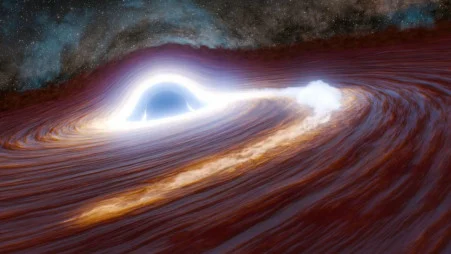
Astronomers discovered the most significant and farthest blaze from a Supermassive Black Hole.
(SMBH) ever recorded in time. Nicknamed the ‘Superman,’ the black hole resides 10 billion light-years away with a light emission of 10 trillion suns. An SMBH is a black hole with a mass that is
hundreds of thousands to billions of times that of our sun.
hundreds of thousands to billions of times that of our sun.
Around August of 2025, the SMBH released a devastatingly gargantuan flare of power
and brightness. The astronomic team looked into what object the SMBH could have devoured to
release such a monstrous glare. Strickland claimed that the “flare suggests there are unknown
populations of giant stars near the centers of large galaxies, which also host supermassive black
holes, and sheds light on the complicated interactions between two behemoths”(CNN
Science). In the end, they concluded that it must have swallowed a massive star, giving the
SMBH is in its flare.
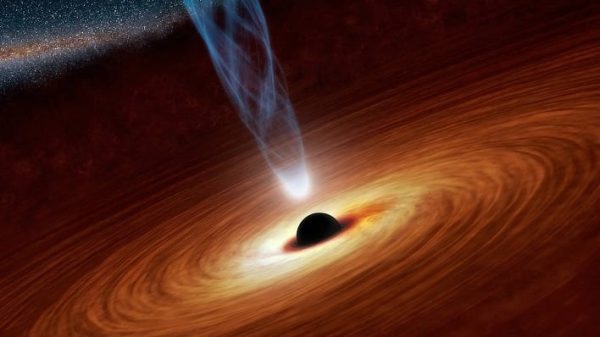 Initially, the object did not seem out of place; the only issue was its brightness. If the star was sucked in and torn apart, it is displayed as a tidal disruption, which must have started this scenario, according to the National Center for Biotechnology Information. Throughout this time, when it was being revealed, a research professor claimed that “About 1 in 10,000 AGN show some sort of flaring activity, but this is so extreme that it puts it into its own category (which is roughly a 1 in a million event)”(Graham). The star is experiencing a slow and painful death. The Supermassive Black Hole is still devouring the star. In space, it takes longer to observe objects and events than on Earth. In space, the SMBH flare light took around 10 billion years to reach Earth. The light of the flare reaches us long after the event, but the flare itself lasts many years: “Seven years here is two years there. We are watching the event play back at quarter speed”(Graham). The phenomenon of watching an event unfold that occurred lifetimes ago is a privilege many people do not realise. The design of the space is intricate and specific.
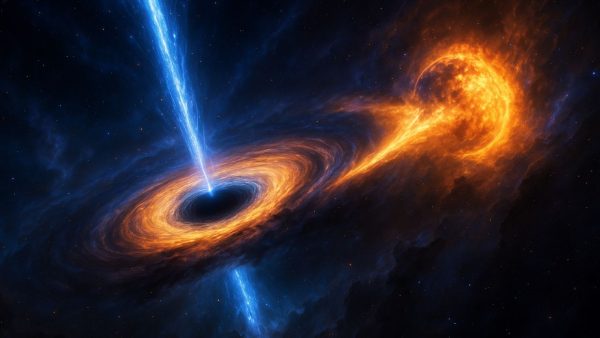 This discovery provides astronomers with a broader perspective. This SMBH opened its eyes to the possibility of other SMBH events. This discovery poses a challenge to the previously established understanding of the relationship between stars and black holes. The “discovery represents an astonishing leap in our understanding of the universe’s most powerful events,” explained Dr. Milisavljevic, not in current research on this SMBH, but on the previous “Scary Barbie” event.
The extraordinary flare exceeds the “Scary Barbie” event, but also challenges the astronomers to reconsider how supermassive black holes develop and interact with their surroundings. During the fading glow, scientists hope to learn more about the hidden population of giant stars that may reside within the galaxy. The Universe is a strange and dangerous place. We may learn lessons from it, like Superman, if we are patient enough to wait around for the ancient dramas that have taken place before us.